The siddur
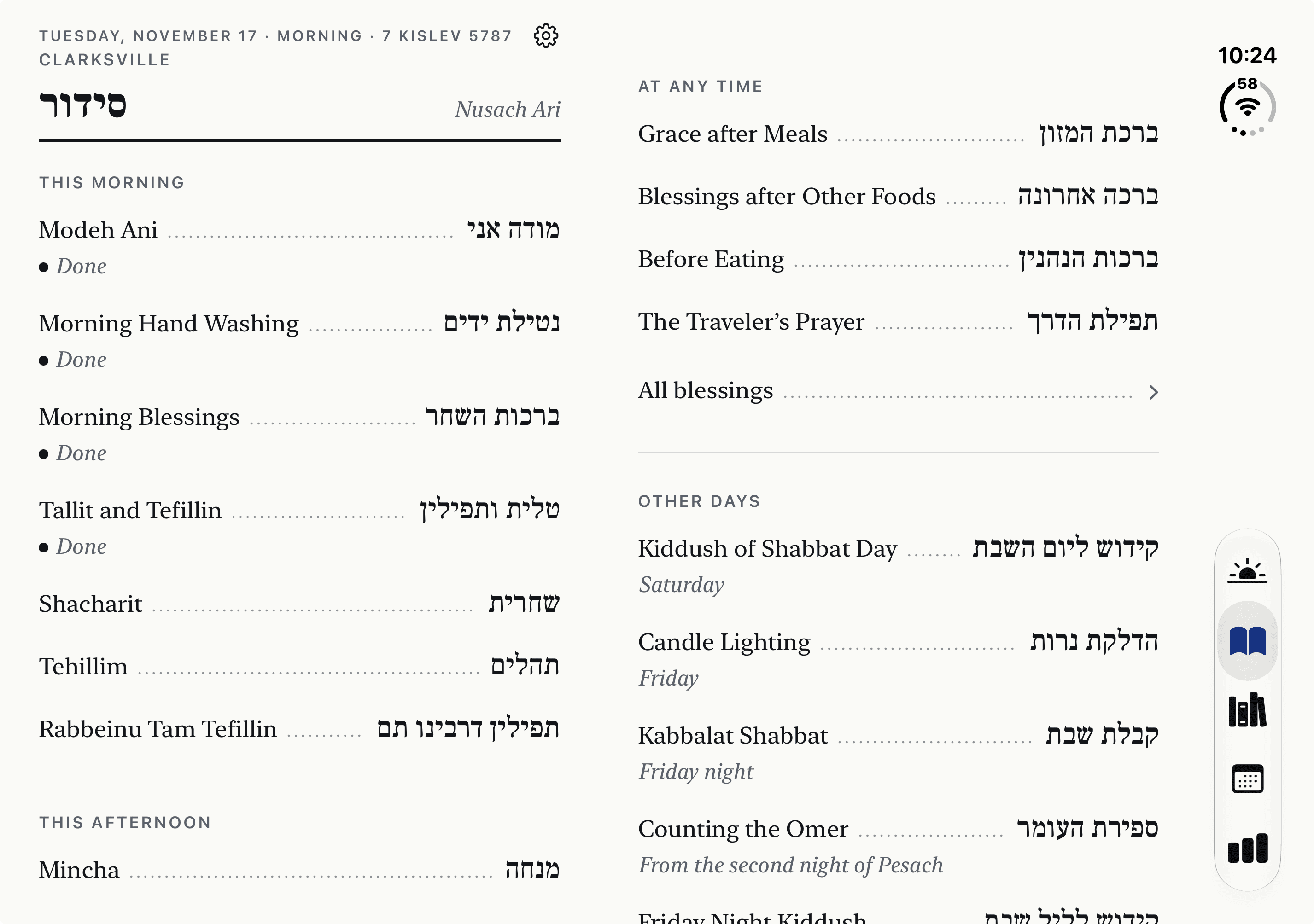
The prayers of the day in Nusach Ari, the rite of the Alter Rebbe’s siddur, in Hebrew, with transliteration and English when you want them.
What the day adds or leaves out is worked out for you. On iPhone Duo it opens as a book.
Coming soon to the App Store
A free week, then $18 a month or $180 a year. For iPhone and iPhone Duo.

What it holds
The weekday prayers, Shacharit, Mincha and Maariv, with the morning blessings, the Grace after Meals, the bedtime Shema and the blessings of the day; and the prayers of Shabbat and the festivals. As the siddur’s contents name them:
- Modeh Ani, Morning Hand Washing and the Morning Blessings
- The Morning Shema, Tallit and Tefillin, and Rabbeinu Tam Tefillin
- Shacharit, Mincha and Maariv
- Counting the Omer and the Bedtime Shema
- Grace after Meals, Blessings after Other Foods, and Blessings
- Candle Lighting, Kabbalat Shabbat, Maariv for Shabbat and the Friday Night Kiddush
- Shacharit for Shabbat, the Kiddush of Shabbat Day, Mincha for Shabbat and Havdalah
- Maariv, Shacharit and Mincha for Festivals, with Kiddush for festival nights and days, and Eruv Tavshilin
- Chanukah Lights and the blessings of the Megillah
- Kiddush Levanah, the Traveler’s Prayer, and Tehillim for each day of the month
What it does not hold: the services of Rosh Hashanah and Yom Kippur, Selichot and Hoshanot, and what is read from a scroll are not in this siddur. Where a service or a passage is said and its text is not here, the page says so.
Hebrew, with transliteration and English when you want them
The Hebrew is always shown. Transliteration and English are two switches, so you can read the Hebrew alone, with one of them, or with both.
The page can be set phrase by phrase, each Hebrew phrase with its transliteration and English beside it, or in paragraphs. The text has its own size setting.

What the day adds or leaves out
What the day adds or leaves out is worked out for you: Mercaz knows the date and the kind of day it is, and sets out each service as that day has it.
Say whether you are praying alone or with a minyan, and the page follows.
The Morning Shema has a reading of its own, after the morning blessings. For someone who puts on tefillin, the reading for tallit and tefillin goes on into the Shema, said again while wearing them.
This siddur sets out the text. A practical question of how or when to pray is one for a rabbi.
From Today to the page
When a prayer’s time is open, Today offers “Open in the siddur”, and the siddur opens at that prayer. If you choose, a practice is marked done when you finish reading it, and the screen stays awake while you read.
On iPhone Duo, an open book
On iPhone Duo the siddur opens as a book: the English on one page and the Hebrew on the facing page, phrase beside phrase. Mercaz on iPhone Duo.

The text and its credits
The siddur’s text is credited in the app under About, in “Acknowledgements”. The same credits, word for word:
Hebrew text
The siddur of Rabbi Schneur Zalman of Liadi, in Nusach Ari, is a work in the public domain. The Hebrew text is taken from “Weekday Siddur Chabad” as published by Sefaria, in the version titled “Wikisource”, which was transcribed by contributors to Hebrew Wikisource and the Open Siddur Project. The Hebrew of the blessings over the Shabbat and festival candles, of havdalah, of Shalom Aleichem, Eshet Chayil and the Friday-night Kiddush, of Veyiten lecha, of the passages of Grace after Meals for Shabbat and the festivals, of Al Hamichyah’s passages for Shabbat and the festivals, and of Hakol yoducha, the Kedushah of Shabbat morning and the passages of the Kiddush of Shabbat day that the Open Siddur typing does not give, is taken in the main from The Metsudah Siddur (Metsudah Publications, 1981) as published by Sefaria in “Shabbat Siddur Sefard Linear” under a Creative Commons Attribution licence. The Hebrew of the verses said while winding the tefillin strap around the finger, and of the blessings over fragrant trees and fragrant herbs, is taken from The Metsudah Siddur as published by Sefaria in “Weekday Siddur Sefard Linear” under a Creative Commons Attribution licence. The Hebrew of the afternoon prayers of Friday, of Kabbalat Shabbat and of the Friday evening service is taken from “Siddur Torah Or: Kabbalat Shabbat”, typed by Shmuel Gonzales and published on Hebrew Wikisource under the Creative Commons Attribution-ShareAlike licence. The Hebrew of the morning, additional and afternoon prayers of Shabbat and of the Kiddush of Shabbat day is taken from “Siddur Torah Or: Shacharit and Musaf for Shabbat”, “Siddur Torah Or: Mincha for Shabbat” and “Siddur Torah Or: The Shabbat Book”, and the Hebrew of the festivals’ own prayers, Kiddush, Yizkor and Eruv Tavshilin from “Siddur Torah Or: Prayers for the Three Festivals”, typed by Shmuel Gonzales and published by the Open Siddur Project under Creative Commons licences; Mercaz uses them under the Creative Commons Attribution-ShareAlike licence. The Hebrew of the psalms of daily Tehillim is taken from the public-domain text of “Psalms” published by Sefaria as Tanach with Nikkud. Mercaz changed these texts: it corrected errors of transcription, made the spelling of the divine name and the punctuation uniform, removed the marks of stress and of cantillation, supplied a few words that the sources lack or print without vowels, and divided the text anew. The Hebrew text as Mercaz shows it is offered under the Creative Commons Attribution-ShareAlike 4.0 International licence, and you may copy and share it under the terms of that licence.
- Weekday Siddur Chabad on Sefaria
- Shabbat Siddur Sefard Linear on Sefaria
- Weekday Siddur Sefard Linear on Sefaria
- Siddur Torah Or: Kabbalat Shabbat on Hebrew Wikisource
- Siddur Torah Or: Shacharit and Musaf for Shabbat on the Open Siddur Project
- Siddur Torah Or: Mincha for Shabbat on the Open Siddur Project
- Siddur Torah Or: The Shabbat Book on the Open Siddur Project
- Siddur Torah Or: Prayers for the Three Festivals on the Open Siddur Project
- Psalms on Sefaria, Tanach with Nikkud
- Creative Commons Attribution-ShareAlike 4.0 International
- Creative Commons Attribution 3.0 Unported
- Public Domain Mark 1.0
English translation
Adapted from The Metsudah Siddur, translated by Rabbi Avrohom Davis (Metsudah Publications, 1981), as published by Sefaria in “Weekday Siddur Sefard Linear” and “Shabbat Siddur Sefard Linear” under a Creative Commons Attribution licence. The translation has been modified. Mercaz changed it to follow Nusach Ari: the divine names are written “G‑d” and “L‑rd”, some Hebrew words are spelled as this siddur transliterates them, the footnotes are left out, misprints are corrected, the wording is changed where the two rites differ, and Mercaz has added translations of its own for passages that the Metsudah translation does not have. The English of the psalms of daily Tehillim is adapted from “Psalms” in The Holy Scriptures: A New Translation (Jewish Publication Society, 1917), as published by Sefaria, which is in the public domain; its older forms of English are modernized and the divine names are written “G‑d” and “L‑rd”. The instructions are by Mercaz.
Transliteration
Made by Mercaz from the Hebrew text above and offered under the same licence as that text, the Creative Commons Attribution-ShareAlike 4.0 International licence.
Frank Ruhl Libre
Copyright 2015 The Frank Ruhl Libre Project Authors (https://github.com/fontef/frankruhllibre) The Hebrew of the siddur is set in Frank Ruhl Libre, offered under the SIL Open Font License 1.1.